
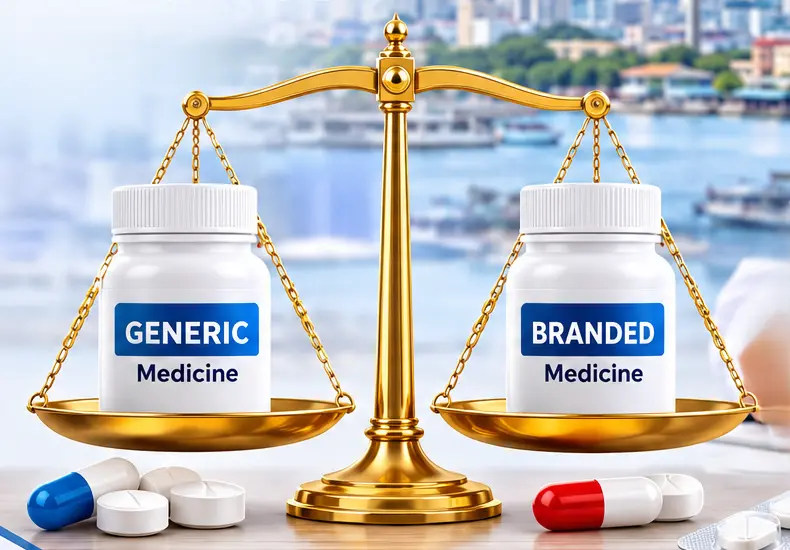
When comparing medicines in the Philippines, one of the most common questions is: Are generic medicines as good as branded medicines?
The answer isn’t simply that one is better than the other.
An appropriately approved generic medicine is intended to provide comparable therapeutic benefits to its corresponding reference medicine while often offering a more affordable option. However, medicines can differ in areas such as manufacturer, appearance, packaging, inactive ingredients, formulation, availability, and price.
For patients, the most important factors are the active ingredient, strength, dosage form, quality, regulatory status, authenticity, and appropriate medical advice.
This guide explains the difference between generic and branded medicines in the Philippines, why prices can vary, how patients can verify medicine information, and what to consider when comparing generic and branded cancer medicines.
What Is a Generic Medicines?
A generic medicine is a medicine identified by the generic name of its active pharmaceutical ingredient.
For example, imatinib is the generic name of an active ingredient used in certain cancer treatments. Different manufacturers may produce medicines containing imatinib under different product or brand names.
A generic medicine should not automatically be considered a “lower-quality” version of a branded medicine.
For medicines that require demonstration of equivalence, generic manufacturers may need to demonstrate that their product meets applicable quality standards and is bioequivalent or therapeutically equivalent to the relevant reference product. The World Health Organization states that multisource generic products must satisfy the applicable standards and provide assurance of clinical interchangeability where the relevant requirements are met.
The exact regulatory requirements can vary according to the medicine and the applicable national rules.
What Is a Branded Medicines?
A branded medicine is marketed under a specific brand or trade name.
A pharmaceutical company may develop and introduce a medicine under a particular brand. Other manufacturers may subsequently market approved products containing the same active ingredient when permitted by applicable patent, regulatory, and market requirements.
A branded medicine may therefore have a recognizable name, packaging, and manufacturer.
However, a higher price or greater brand recognition does not by itself prove that a medicine is more effective.
The important consideration is whether the particular medicine is appropriate, authentic, and compliant with applicable regulatory requirements.
Generic vs Branded Medicines: What's the Difference?
The main differences can be summarized below.
| Factor | Generic Medicine | Branded Medicine |
|---|---|---|
| Name | Usually identified by its generic name or a manufacturer’s brand | Marketed under a specific brand/trade name |
| Active ingredient | Contains the specified active ingredient | Contains the specified active ingredient |
| Therapeutic purpose | Used for its approved indication | Used for its approved indication |
| Quality requirements | Must meet applicable regulatory requirements | Must meet applicable regulatory requirements |
| Bioequivalence | Required where applicable to establish equivalence | Reference product may be used as comparator |
| Manufacturer | May be produced by a different manufacturer | Associated with a particular brand/manufacturer |
| Appearance | May differ | Brand-specific |
| Packaging | May differ | Brand-specific |
| Inactive ingredients | May differ | May differ |
| Price | Often lower | May be higher, but varies by product |
The key takeaway is simple:
Generic versus branded is not the same as inferior versus superior.
The specific product, regulatory status, quality, authenticity, and suitability for the patient matter more than the name printed on the package.
Are Generic Medicines as Effective as Branded Medicines?
For an appropriately approved generic medicine, the purpose is to provide comparable therapeutic performance to the relevant reference medicine when the applicable equivalence requirements have been satisfied.
One important concept is bioequivalence.
Bioequivalence evaluates whether a generic medicine performs sufficiently similarly to its comparator under the applicable regulatory standards.
WHO explains that a multisource generic product may need to demonstrate bioequivalence to establish therapeutic equivalence or clinical interchangeability with the relevant comparator.
However, this does not mean that patients should independently replace any branded medicine with any product carrying the same generic name.
The appropriate product can depend on:
- Active ingredient
- Strength
- Dosage form
- Formulation
- Patient-specific factors
- Treatment plan
- Applicable regulatory requirements
For prescription medicines particularly cancer medicines and other specialty medicines, patients should ask their doctor or pharmacist before changing products.
Are Generic Medicines Safe?
An appropriately authorized generic medicine is subject to applicable regulatory requirements.
However, the word “generic” alone does not prove that a particular product is genuine or appropriate.
The source of the medicine matters.
Before purchasing a medicine, patients should consider:
- Whether the product can be verified
- Whether the manufacturer is clearly identified
- Whether the packaging is intact
- Whether the medicine is within its expiry date
- Whether storage requirements have been followed
- Whether the supplier is legitimate
- Whether the product information is consistent
The Food and Drug Administration (FDA) operates a Verification Portal that provides public access to information about licensed establishments and registered or notified health products.
The FDA also publishes package inserts and patient information leaflets for registered drug products through its Verification Portal.
This makes the official FDA resources useful when checking medicine information.
Why Are Generic Medicines Often Cheaper?
One major reason patients consider generic medicines is affordability.
Developing an original medicine can involve substantial research, development, clinical studies, regulatory work, manufacturing, and commercialization.
When approved generic manufacturers enter a market, they may not have to repeat every stage of the original medicine-development process. Competition between manufacturers can also influence prices.
Other factors that can affect medicine prices include:
- Manufacturer
- Manufacturing costs
- Distribution
- Packaging
- Importation and logistics
- Market competition
- Medicine strength
- Pack size
- Availability
- Supplier or retail margins
As a result, generic medicines are often less expensive than branded alternatives, but there is no universal price difference that applies to every medicine.
Does a Higher Medicine Price Mean Better Quality?
Not necessarily.
Price alone does not establish the quality, safety, or effectiveness of a medicine.
Likewise, a lower price does not automatically mean that a medicine is poor quality.
When comparing medicines, patients should look beyond the price and consider:
- Active ingredient
- Strength
- Dosage form
- Manufacturer
- Regulatory information
- Authenticity
- Storage conditions
- Source of supply
- Professional medical advice
WHO’s regulatory guidance emphasizes quality, safety, efficacy, stability, packaging, storage, and bioequivalence as important aspects of pharmaceutical regulation.
Generic vs Branded Cancer Medicines
The comparison can become particularly important when discussing cancer medicines.
Cancer treatment may involve prescription medicines that can be expensive, so patients and caregivers may research generic and branded options containing the same active ingredient.
Depending on the type of cancer and treatment plan, patients may encounter medicines such as:
- Abiraterone
- Enzalutamide
- Imatinib
- Lenalidomide
- Lenvatinib
- Olaparib
- Osimertinib
- Venetoclax
- Ibrutinib
- Sorafenib
The availability of generic and branded versions can vary depending on the medicine, manufacturer, regulatory status, market, and supply.
What should cancer patients compare?
Rather than asking only:
“Is this generic or branded?”
patients should consider:
- Is the active ingredient correct?
- Is the prescribed strength correct?
- Is the dosage form correct?
- Is the product appropriately authorized?
- Can the manufacturer be identified?
- Can the product information be verified?
- Has the medicine been stored appropriately?
- Is this product suitable for the patient’s treatment plan?
Cancer medicines can have important dosing, interaction, monitoring, and safety considerations.
Patients should never change a cancer medicine solely because another product appears cheaper.
Any substitution or treatment change should be discussed with the treating oncologist, physician, or pharmacist.Why Can Cancer Medicine Prices Differ?
Cancer medicine prices can vary significantly between products and suppliers.
Several factors can contribute to these differences.
Manufacturer
Different manufacturers may establish different prices for products containing the same active ingredient.
Brand and commercialization
Branded products can have different research, development, marketing, distribution, and commercialization costs.
Competition
Multiple manufacturers supplying the same active ingredient can create greater market competition, which may affect prices.
Strength and quantity
Medicine strength and pack size can have a major effect on the total purchase price.
For example, two products containing the same active ingredient but different strengths should not be compared simply on their total package prices.
Availability
Limited supply or availability can affect the price of specialty medicines.
Distribution and logistics
Imported medicines can involve additional supply-chain, logistics, and distribution costs.
Therefore, when comparing prices, patients should compare the same active ingredient, strength, dosage form, and quantity.
How to Compare Generic and Branded Medicines Correctly
Price should not be the only comparison point.
Use this checklist when researching a medicine.
1. Check the active ingredient
Confirm the exact active pharmaceutical ingredient.
2. Check the strength
Make sure the strength matches the prescription.
A medicine with the same generic name but a different strength is not automatically an appropriate substitute.
3. Check the dosage form
Tablets, capsules, injections, oral solutions, and modified-release formulations can have different characteristics.
4. Check the manufacturer
Identify the company responsible for manufacturing the medicine.
5. Check regulatory information
For products marketed in the Philippines, use appropriate Philippine FDA resources to verify product information where applicable.
6. Check the expiry date
Never use an expired medicine.
7. Check the packaging
Look for intact packaging and consistent product information.
8. Check storage requirements
Some medicines require specific storage conditions.
9. Follow the prescription
Do not change the dose, formulation, or medicine without professional guidance.
How to Verify a Medicine In The Philippines
The Philippine FDA Verification Portal provides publicly accessible information about licensed establishments and registered or notified health products.
Depending on the product and information available, consumers may be able to review details such as:
- Generic name
- Brand name
- Product registration information
- Dosage strength
- Dosage form
- Manufacturer
- Country of origin
- Product classification
The FDA also provides approved package inserts and patient information leaflets for registered drug products through the portal.
Official resource
Philippine FDA Verification Portal:
FDA Verification Portal
If product information does not appear to match the medicine being considered, speak with a pharmacist or contact the appropriate regulatory authority before using it.
Buying Medicines Online in the Philippines
Buying medicines online can be convenient, particularly when patients are researching medicines that may not be readily available nearby.
However, online purchasing requires careful consideration.
Before ordering a medicine online, ask:
- Can I identify the seller?
- Is the manufacturer clearly identified?
- Can the product information be verified?
- Is the medicine prescription-only?
- Does the seller provide appropriate product information?
- Are storage requirements considered?
- Are shipping conditions appropriate for the product?
- Is the supplier transparent about the source of the medicine?
Be cautious about websites that make unrealistic medical claims, promise guaranteed cures, or provide little information about the product or supplier.
For prescription and specialty medicines, patients should also follow the advice of their healthcare professional.
How LetsMeds Can Help With Medicine Information
LetsMeds provides generic and branded medicines, including specialty and oncology medicines.
Patients and caregivers researching a particular medicine can contact LetsMeds to request information about product availability and pricing. Availability can change based on product, manufacturer, supply, and market conditions.
When asking about a medicine, providing the following information can make a comparison more accurate:
- Generic or medicine name
- Strength
- Dosage form
- Required quantity
LetsMeds can provide product and pricing information, but medicine selection and treatment decisions should remain with a qualified healthcare professional.
Patients should consult their physician, oncologist, or pharmacist before starting, stopping, substituting, or changing a prescription medicine.
Generic vs Branded Medicines: Which Is Better?
There is no universal answer that one category is always better.
For an appropriately authorized generic medicine that meets the applicable requirements, the lower price does not automatically mean lower quality or effectiveness.
At the same time, patients should not assume that every medicine with the same generic name is automatically interchangeable with every branded product.
The better approach is to compare:
Active ingredient + strength + dosage form + regulatory status + manufacturer + authenticity + medical advice
For cancer and other specialty medicines, professional guidance is especially important.
A Simple Checklist Before Choosing a Medicine
Before buying or switching a medicine, consider these nine questions:
| Question | Why it matters |
|---|---|
| What is the active ingredient? | Identifies the medicine |
| What strength is prescribed? | Helps avoid dosing mistakes |
| What is the dosage form? | Different forms may not be interchangeable |
| Who manufactured it? | Helps identify the product |
| Can the product be verified? | Supports product verification |
| Is the packaging intact? | Helps identify possible issues |
| Is it within the expiry date? | Important for medicine quality |
| Has it been stored correctly? | Some medicines have specific storage requirements |
| Has a healthcare professional approved the change? | Important for prescription medicine |
Conclusion
Prostate cancer remains a significant health concern for Filipino men, but advances in screening, diagnosis, and treatment continue to improve outcomes. Recognizing symptoms early, discussing PSA screening with your healthcare provider when appropriate, and receiving timely specialist evaluation can make a substantial difference in treatment success.
For men with advanced prostate cancer, therapies such as Abiraterone and Enzalutamide have expanded treatment options and may help slow disease progression in eligible patients. Because every case is unique, treatment decisions should always be made in consultation with a qualified oncologist or urologist.
If you have been prescribed specialty medicines for prostate cancer, trusted providers such as LetsMeds can help patients access quality generic and branded oncology medicines. Always use these medications under the supervision of your treating physician and follow the prescribed treatment plan.
Frequently Asked Questions
Generic medicines are often more affordable than branded alternatives, but the actual difference varies according to the medicine, manufacturer, strength, quantity, supplier, availability, and other market factors.
An appropriately authorized generic medicine that meets the applicable equivalence requirements is intended to provide comparable therapeutic performance to its relevant reference product. WHO identifies bioequivalence as an important part of establishing interchangeability for applicable multisource medicines.
An appropriately authorized generic cancer medicine must meet the applicable regulatory requirements. However, cancer medicines should be used according to the patient’s treatment plan and under appropriate medical supervision.
Do not make the switch independently. Ask your doctor or pharmacist whether the specific product is an appropriate alternative for your prescription.
Prices can be influenced by research and development, manufacturing, marketing, distribution, brand-related costs, competition, supply, and other commercial factors.
No. Price alone does not establish medicine quality. Regulatory status, manufacturing quality, authenticity, storage, and supply source are more meaningful considerations.
The Philippine FDA provides a Verification Portal where consumers can access information about registered or notified health products and licensed establishments.
Availability and purchasing requirements vary by medicine. Many cancer medicines are prescription medicines and should be used under medical supervision. When researching an online supplier, verify the product, manufacturer, source, and relevant regulatory information before purchasing. Always choose trusted provider like Letsmeds.
Prices can vary between manufacturers and suppliers. Compare the same active ingredient, strength, dosage form, and quantity. LetsMeds can provide information about medicine availability and pricing for products within its supply network.
Key Takeaways
Generic and branded medicines can differ in name, manufacturer, packaging, appearance, inactive ingredients, formulation, availability, and price.
An appropriately authorized generic medicine that meets applicable requirements can provide comparable therapeutic benefits to its relevant reference medicine. However, patients should not assume that every product with the same generic name is automatically interchangeable.
For patients in the Philippines, consider:
- Active ingredient
- Correct strength
- Dosage form
- Regulatory information
- Manufacturer
- Authenticity
- Storage conditions
- Supplier
- Professional medical advice
For cancer and other specialty medicines, never change treatment simply because another product appears cheaper. Discuss any proposed substitution with your doctor, oncologist, or pharmacist.
LetsMeds can provide information about medicine availability and pricing, while treatment and substitution decisions should remain with an appropriate healthcare professional.
Sources & References
- World Health Organization (WHO): Guidance on bioequivalence and multisource/generic medicines.
- Philippine Food and Drug Administration (FDA): Verification Portal and registered health-product information.
- Philippine FDA: Package inserts and patient information leaflets for registered drug products.
- WHO: 2026 International Comparator Products guidance for equivalence assessment.
Medical disclaimer: This article provides general educational information and is not a substitute for advice from a physician, pharmacist, oncologist, or other qualified healthcare professional. Do not start, stop, substitute, or change a prescription medicine without appropriate medical guidance.