Non-Small Cell Lung Cancer (NSCLC): Symptoms, Stages, Diagnosis and Treatment
September 28, 2026
Key Takeaways
- Non-small cell lung cancer (NSCLC) is the most common broad type of lung cancer and includes several subtypes, particularly adenocarcinoma and squamous cell carcinoma.
- Symptoms can include a persistent or worsening cough, chest discomfort, shortness of breath, coughing up blood, hoarseness, fatigue and unexplained weight loss, although some people have few or no symptoms initially.
- Diagnosis usually involves imaging and examination of a tissue or cell sample. Staging determines how far the cancer has spread.
- Biomarker testing is an important part of treatment planning, particularly for advanced NSCLC, because certain genetic changes can make targeted therapies appropriate.
- EGFR mutations are among the molecular changes that can influence treatment. Osimertinib is an EGFR-targeted therapy used for certain patients with EGFR-mutated NSCLC; it is not a treatment for every person with NSCLC.
- NSCLC treatment may involve surgery, radiation therapy, chemotherapy, immunotherapy, targeted therapy, or combinations of these approaches depending on stage, tumor characteristics, biomarkers and overall health.
- In the Philippines, patients may need to consider specialist oncology care, diagnostic testing, medicine availability and treatment access when planning care.
- A cancer diagnosis should be discussed with a qualified healthcare professional who can interpret the pathology, imaging and biomarker results together.
What Is Non-Small Cell Lung Cancer?
Non-small cell lung cancer, commonly abbreviated as NSCLC, is a group of lung cancers that generally grow and behave differently from small cell lung cancer (SCLC).
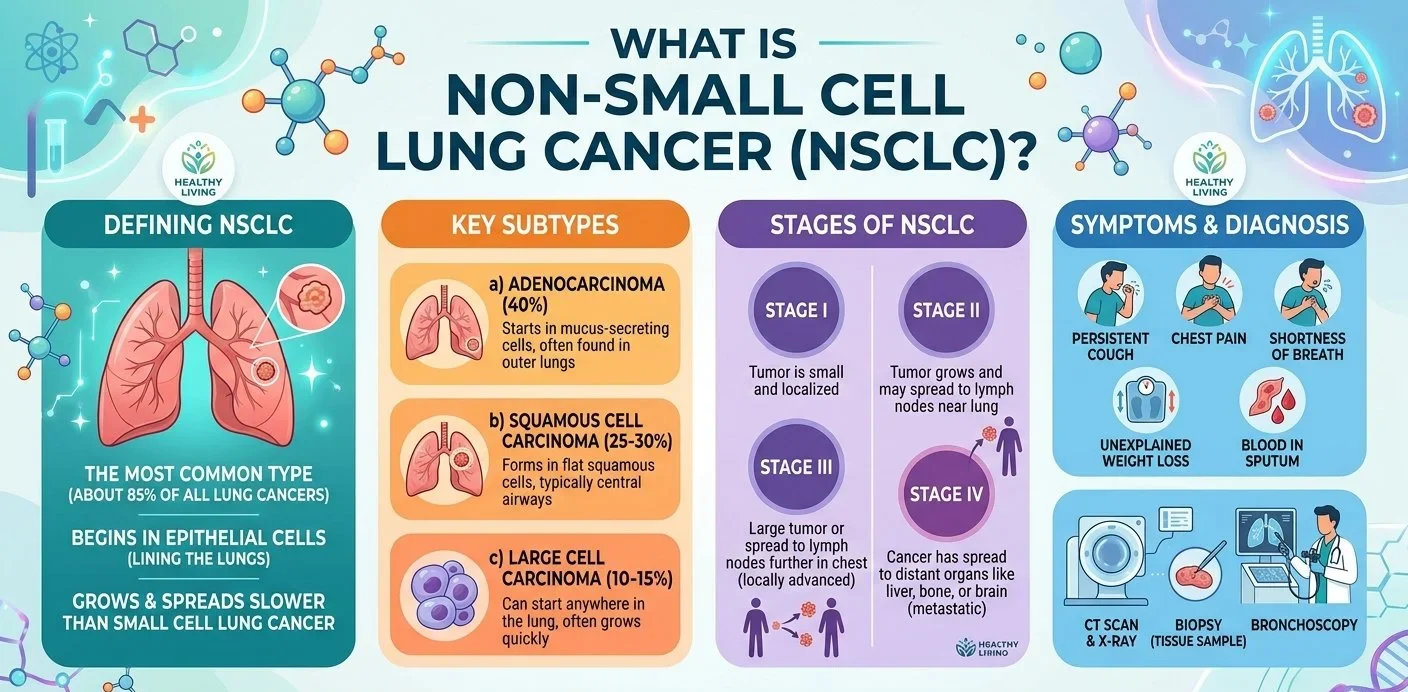
NSCLC accounts for the large majority of lung cancers. Major NSCLC subtypes include adenocarcinoma, squamous cell carcinoma and large cell carcinoma. Adenocarcinoma is the most common subtype.
The distinction matters because the type of lung cancer can affect the diagnostic work-up and treatment strategy.
NSCLC can be localized to the lung, involve nearby lymph nodes or structures, or spread to distant parts of the body. Doctors use staging and other clinical information to describe the extent of disease and help determine treatment.
Importantly, NSCLC is not one single disease with one standard treatment. Two people can both have NSCLC but receive different treatments because their cancers have different stages, histologic features or molecular profiles.
What Are the Main Types of NSCLC?
The three major categories traditionally used to describe NSCLC are:
Adenocarcinoma
Adenocarcinoma develops from cells with gland-like characteristics and is the most common type of lung cancer. It can occur in people who smoke, former smokers and people who have never smoked.
Because adenocarcinoma can contain actionable molecular alterations, biomarker testing can be particularly important when treatment decisions are being made.
Squamous Cell Carcinoma
Squamous cell carcinoma develops from squamous cells lining the airways. It has historically been associated more strongly with smoking and often develops closer to the central airways.
Large Cell Carcinoma
Large cell carcinoma is a less common NSCLC subtype. The term describes tumors whose cells have certain microscopic characteristics and that do not fit more specific categories. Pathology can be more detailed than these broad labels. A pathology report may contain additional information about tumor differentiation, growth patterns and other characteristics.
What Are the Symptoms of NSCLC?
One of the biggest challenges is that early-stage prostate cancer often causes no noticeable symptoms. Many men are diagnosed after a routine PSA blood test or physical examination.
As the disease progresses, symptoms may begin to appear.
Common Symptoms
- Frequent urination, especially at night
- Difficulty starting urination
- Weak urine stream
- Interrupted urine flow
- Difficulty emptying the bladder
- Pain or burning during urination
- Blood in the urine
- Blood in semen
- Pain during ejaculation
These symptoms can also occur with non-cancerous conditions such as benign prostatic hyperplasia (BPH) or prostatitis, making proper medical evaluation essential.
What Causes NSCLC?
There is no single cause of NSCLC.
The strongest established risk factor for lung cancer is tobacco smoking, although lung cancer can also occur in people who have never smoked. WHO identifies secondhand smoke, air pollution and occupational exposures such as asbestos, silica and diesel exhaust among other risk factors.
Other factors can include:
- Secondhand tobacco smoke
- Occupational exposure to carcinogens
- Air pollution
- Radon exposure
- Certain chronic lung conditions
- Family or genetic susceptibility
Importantly, risk factors do not determine whether a particular person will develop cancer.
A person who has never smoked can still develop NSCLC, and smoking history alone cannot determine the type or molecular profile of a tumor.
How Is NSCLC Diagnosed?
Diagnosis usually involves several pieces of information rather than one test.
1. Medical history and examination
A doctor may review symptoms, smoking history, occupational exposures, previous illnesses and other relevant health information.
2. Imaging
Imaging may include:
- Chest X-ray
- CT scan
- PET/CT in appropriate situations
- MRI, particularly when assessment of the brain or other areas is clinically indicated
Imaging can identify a suspicious lesion and help assess whether cancer may have spread.
3. Biopsy
A biopsy or other tissue/cell sampling procedure may be required to establish the diagnosis.
Depending on the location of the suspected tumor, tissue may be obtained through procedures such as bronchoscopy, needle biopsy or surgery.
4. Pathology
A pathologist examines the sample to determine whether cancer is present and, when possible, what type of lung cancer it represents.
5. Molecular and biomarker testing
For many patients, particularly those with advanced NSCLC, the diagnostic process does not end with identifying the cancer type.
Testing may look for molecular alterations that can influence treatment selection. Depending on the clinical situation, testing may include genes such as EGFR, ALK, ROS1, BRAF, KRAS, MET and RET, among others.
PD-L1 testing may also be relevant when evaluating potential immunotherapy options. Current molecular testing approaches increasingly use broader panels when appropriate so that potentially actionable alterations are not missed.
What Are the Stages of NSCLC?
Staging describes how far the cancer has spread.
NSCLC staging uses the TNM system, which evaluates:
- T: the primary tumor’s size and local extent
- N: involvement of nearby lymph nodes
- M: spread to distant sites
These findings are then combined into an overall stage.
The major stage groups include:
- Stage 0
- Stage I
- Stage II
- Stage III
- Stage IV
The current NSCLC staging system is more detailed than simply saying “early” or “late” stage. For example, Stage III contains several subgroups, and Stage IV can also be divided according to the pattern and extent of metastatic spread.
Stage 0
Stage 3
Stage 4
Stage 1
Stage 2
Abnormal cells are confined to the surface lining and have not invaded deeper lung tissue.
Cancer is localized to the lung without involvement of certain regional lymph nodes. Treatment may involve surgery or other local approaches depending on the tumor and the patient’s health.
Cancer may be larger or may involve nearby lymph nodes. Surgery can still play an important role for selected patients, often alongside additional treatment.
Cancer has spread more extensively within the chest, including certain lymph-node regions or nearby structures. Treatment can involve combinations of chemotherapy, radiation, surgery, immunotherapy or targeted therapy depending on the exact situation.
Cancer has spread beyond the original region, including distant organs or other sites. Treatment is generally based heavily on tumor biology, molecular findings, disease distribution and the patient’s overall condition.
How Is NSCLC Treated?
There is no single “NSCLC treatment.”
Treatment is selected according to factors such as:
- Stage
- Histologic subtype
- Biomarker results
- Tumor location
- Whether surgery is possible
- Previous treatment
- Overall health
- Symptoms
- Patient preferences and goals
WHO identifies surgery, radiotherapy, chemotherapy, targeted therapy and immunotherapy among the major treatment approaches for lung cancer.
Surgery
Surgery may be considered when NSCLC is localized and the tumor can be removed safely.
Procedures can include:
- Wedge resection
- Segmentectomy
- Lobectomy
- More extensive lung resection in selected circumstances
The choice depends on tumor characteristics and the person’s ability to tolerate surgery.
Radiation Therapy
Radiation therapy uses high-energy radiation to damage cancer cells.
It may be used:
- As a primary local treatment when surgery is not appropriate
- Before or after surgery in selected cases
- Alongside chemotherapy for certain locally advanced cancers
- To relieve symptoms caused by advanced disease
Chemotherapy
Chemotherapy uses medicines that affect rapidly dividing cells.
It may be used before surgery, after surgery, with radiation, or as part of systemic treatment for advanced disease.
The specific drugs and schedule depend on the cancer’s characteristics and treatment setting.
Immunotherapy
Immunotherapy helps the immune system recognize or attack cancer.
Its use can depend partly on biomarkers such as PD-L1 and on other characteristics of the tumor and patient.
PD-L1 testing has an established role in helping clinicians evaluate immunotherapy options in appropriate NSCLC settings.
What Is Biomarker Testing in NSCLC?
Biomarker testing looks for specific characteristics in cancer cells that can help guide treatment.
Think of it as moving from:
“What type of lung cancer is this?”
to:
“What specific biological features does this cancer have?”
Depending on the clinical situation, testing can identify alterations involving genes or proteins such as:
- EGFR
- ALK
- ROS1
- BRAF
- KRAS
- MET
- RET
- ERBB2/HER2
PD-L1 is a different type of biomarker that can also help inform treatment decisions.
Broader molecular testing, including next-generation sequencing in appropriate patients, may identify more than one potentially actionable alteration from the same testing strategy.
This information can be especially important before systemic treatment is selected for advanced NSCLC.
What Is EGFR-Mutated NSCLC?
EGFR stands for epidermal growth factor receptor.
Certain mutations in the EGFR gene can cause signaling pathways that encourage cancer cells to grow.
When NSCLC contains an actionable EGFR mutation, doctors may consider an EGFR tyrosine kinase inhibitor (TKI) rather than treating the patient solely according to the cancer’s stage or histologic subtype.
Common clinically important EGFR alterations include exon 19 deletions and exon 21 L858R mutations.
However, not every EGFR alteration has the same treatment implications. The exact molecular finding matters.
That distinction is important when reading a pathology or molecular testing report.
Where Does Osimertinib Fit Into NSCLC Treatment?
Osimertinib is an EGFR-targeted tyrosine kinase inhibitor.
It is used for selected patients whose NSCLC has specific EGFR alterations.
The U.S. National Cancer Institute lists osimertinib among treatments approved for adults with EGFR-abnormal NSCLC in several clinical settings, including certain patients after surgical removal, selected unresectable stage III disease following chemoradiation, and advanced/metastatic disease.
The U.S. FDA has also approved osimertinib with platinum-based chemotherapy for certain patients with locally advanced or metastatic NSCLC whose tumors have EGFR exon 19 deletions or exon 21 L858R mutations.
In September 2024, the FDA approved osimertinib for certain adults with unresectable stage III EGFR exon 19 deletion or exon 21 L858R NSCLC whose disease had not progressed during or after platinum-based chemoradiation.
These approvals illustrate an important point:
A patient should not assume that having NSCLC automatically means osimertinib is appropriate.
Is Osimertinib Appropriate for Every EGFR-Positive Patient?
Not necessarily.
Treatment decisions depend on the exact EGFR alteration, stage, prior therapy, treatment setting, regulatory indication and other patient-specific factors.
This is one reason a molecular report should be reviewed by an oncologist rather than interpreted from a medication search result alone.
The broader lesson is useful:
A mutation result is not itself a prescription.
The result needs to be interpreted alongside pathology, staging, imaging and the patient’s clinical situation.
What Are the Goals of Treatment for Different NSCLC Stages?
Treatment goals can change as NSCLC progresses.
For some early-stage cancers, treatment may focus on removing or destroying the cancer with curative intent.
For locally advanced disease, doctors may combine local and systemic treatments to control the tumor and reduce the risk of recurrence.
For metastatic disease, systemic treatment is often central. Depending on tumor biology and response, the goals may include controlling cancer growth, prolonging survival and maintaining quality of life.
NCI’s treatment guidance shows how options vary substantially between early-stage, locally advanced and metastatic NSCLC.
This is why generic statements such as “the best treatment for NSCLC” can be misleading without knowing the stage and molecular profile.
NSCLC Treatment in the Philippines
For patients searching for NSCLC treatment in the Philippines, the practical journey can involve several different parts of the healthcare system.
A patient may need access to:
- A pulmonologist or thoracic specialist
- A medical oncologist
- Pathology services
- CT/PET imaging where clinically appropriate
- Biopsy or bronchoscopy
- Molecular or biomarker testing
- Radiation oncology
- Surgery when appropriate
- Cancer medicines
- Supportive and palliative care
The Philippines has a national cancer-control framework under the Department of Health, with programs covering cancer prevention, treatment access, patient navigation and supportive care.
PhilHealth also issued a 2025 policy covering lung cancer screening for defined high-risk, asymptomatic adults, including people aged 50–80 with specified risk factors.
For people seeking specialist care in Manila, Metro Manila, Quezon City, Makati, Cebu or Davao, the most useful approach is generally to identify an appropriate oncology or lung-care facility rather than choosing a provider solely from an online medicine search.
The DOH has also identified specialty and lung-care facilities within the national healthcare system.
Availability of specific cancer medicines, testing and treatment services can change. Patients should confirm current availability directly with their hospital, oncology team, pharmacy or relevant Philippine regulatory resources.
Checking Cancer Medicine Availability in the Philippines
Medicine availability is a separate question from whether a medicine is medically appropriate.
For prescription cancer medicines, patients and caregivers should pay attention to:
- The exact generic name and strength.
- The prescribing doctor’s instructions.
- Product registration or authorization where applicable.
- The identity of the manufacturer or supplier.
- Packaging and product information.
- Storage and handling requirements.
- Whether the product is being supplied through a legitimate pharmaceutical channel.
The Philippine FDA Verification Portal provides public access to information about registered health products and licensed establishments. The FDA specifically encourages consumers to use its verification system when checking health products.
This is particularly important when medicines are sourced online.
What Should Patients Ask Their Oncologist?
A new NSCLC diagnosis can produce a lot of medical information very quickly. Writing down questions before an appointment can make the discussion easier.
Useful questions include:
About the diagnosis
- What type of NSCLC do I have?
- What does my pathology report mean?
- What stage is the cancer?
- Has the cancer spread outside the lung?
About testing
- Has my tumor been tested for EGFR?
- Should broader molecular testing be performed?
- Have other actionable biomarkers been checked?
- Has PD-L1 been evaluated if relevant to treatment planning?
About treatment
- What are the goals of treatment?
- Is surgery an option?
- Would radiation therapy be appropriate?
- Would chemotherapy, immunotherapy or targeted therapy be considered?
- Is there a clinical trial that may be relevant?
If an EGFR mutation is found
- What exact EGFR alteration was detected?
- Is it one for which targeted therapy is established?
- Is osimertinib an option in my particular treatment setting?
- Would it be used alone or with another treatment?
- What monitoring would be needed?
About practical care
- Where will treatment be provided?
- How often will appointments or treatment occur?
- What side effects should be reported immediately?
- What support is available for treatment costs and medicine access?
The Bottom Line
Non-small cell lung cancer is a broad group of cancers, and treatment is increasingly guided by more than the cancer’s location and stage.
The modern NSCLC treatment pathway can be thought of as:
Symptoms or abnormal imaging → diagnosis → pathology → staging → biomarker testing → treatment selection → monitoring
For some patients, molecular testing reveals an EGFR alteration that opens the possibility of targeted therapy. Osimertinib is one important EGFR-targeted treatment, but it is relevant only to particular patients and clinical situations.
For patients and families, understanding the pathology report, stage and biomarker results can make discussions with the oncology team much more productive.
Medicine access is another part of the journey. Patients researching cancer medicines in the Philippines can use legitimate pharmaceutical and healthcare resources, while verifying products and following the treatment plan established by their healthcare professionals.
Frequently Asked Questions
No. Lung cancer includes several major types. NSCLC is the most common broad category, while small cell lung cancer is another major type.
The major types are adenocarcinoma, squamous cell carcinoma and large cell carcinoma. Adenocarcinoma is the most common.
Persistent cough, shortness of breath, chest discomfort, coughing up blood, hoarseness, fatigue and unexplained weight loss can occur. Some people have no symptoms initially.
Diagnosis may involve imaging, bronchoscopy or another biopsy procedure, pathology examination and, when appropriate, molecular and biomarker testing.
NSCLC is generally staged from Stage 0 through Stage IV, using the TNM system to describe the tumor, lymph-node involvement and distant spread.
It is NSCLC in which testing identifies a relevant mutation in the EGFR gene. Certain EGFR alterations can make a patient eligible for EGFR-targeted therapy.
Targeted therapy uses medicines designed to act on specific molecular characteristics of cancer cells. It is generally considered when the relevant biomarker is present.
Osimertinib is an EGFR-targeted therapy used for selected patients with NSCLC containing specific EGFR alterations and in particular clinical settings. It is not appropriate for every NSCLC patient.
It can be used for certain EGFR-mutated NSCLC, but the exact EGFR alteration, stage and treatment setting matter. A positive EGFR result does not automatically mean osimertinib is appropriate.
Yes. Although tobacco smoking is the major risk factor for lung cancer, NSCLC can also occur in people who have never smoked.
Biomarker testing examines cancer tissue or other appropriate samples for molecular or protein characteristics that may help guide treatment decisions.
Patients can seek evaluation through qualified oncology and lung-care services, including appropriate government and private hospitals. The DOH maintains cancer-control and specialty-care programs, while patients should confirm current services directly with facilities.
References & Authoritative Sources
- National Cancer Institute — Non-Small Cell Lung Cancer Treatment
- National Cancer Institute — Osimertinib Mesylate
- U.S. FDA — Osimertinib With Chemotherapy for EGFR-Mutated NSCLC
- U.S. FDA — Osimertinib for Unresectable Stage III NSCLC
- American Cancer Society — What Is Lung Cancer?
- American Cancer Society — NSCLC Stages
- World Health Organization — Lung Cancer
- Philippines Department of Health — Philippine Cancer Control Program
- PhilHealth — Lung Cancer Screening Policy
- Philippine FDA Verification Portal
This article is for educational and informational purposes only. It is not a substitute for professional medical advice, diagnosis or treatment. NSCLC treatment depends on the individual patient’s pathology, cancer stage, biomarker results, overall health, previous treatment and other clinical factors. Osimertinib and other cancer medicines should be used only under the direction of an appropriately qualified healthcare professional. Do not start, stop, change or substitute a cancer medicine based solely on information in this article. For questions about a diagnosis, treatment plan, prescription or potential side effects, speak with the treating oncologist or another qualified healthcare professional.